Indexable carbide milling cutters
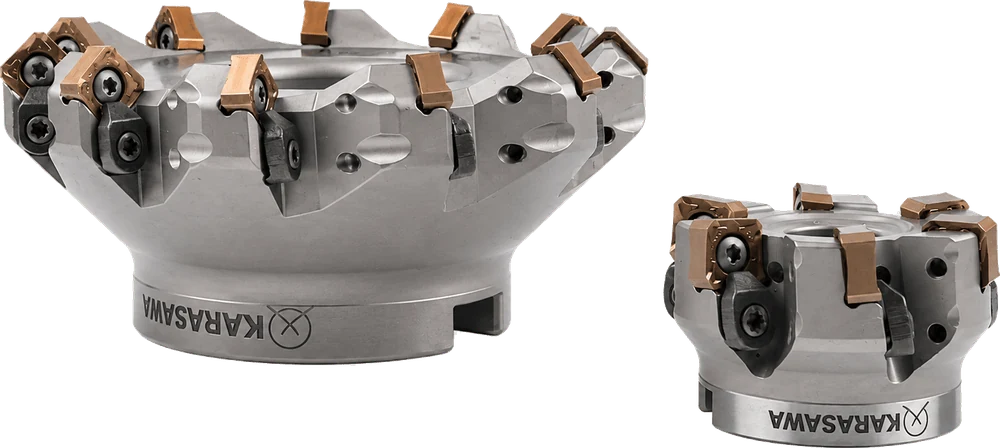
The KARASAWA milling programme covers the whole section: 90° shoulder, face milling, high-feed strategy, copy milling, contouring, indexable end mills and dedicated series for aluminium. The body stays in the machine — only the insert changes.
We reply within the working day. There is no minimum order.
General description
A worn solid end mill goes off to be reground or into the scrap. Here only the insert is consumed and the body works for years. But that only holds if the body keeps its size, the pocket does not get beaten out, and the insert with the geometry you need is in stock when you need it.
Those four things are what the KARASAWA milling programme is built on.
Trigon, square, hexagonal, octagonal, round, parallelogram and round-nose inserts. Positive and negative. Each machining method has its own body rather than one “universal” one being reconfigured.
The bodies carry a purpose-developed wear-resistant coating. That is not cosmetic: the chip polishes the body continuously, and it is usually the worn body — not the insert — that finishes a cutter off.
The same geometry behaves differently in different grades — sometimes the difference in tool life is a multiple. That is why the programme has not one “house” grade but seventeen: PVD, CVD, tungsten-free and diamond.
Common bodies and inserts are held. The cutter that is not there when the machine is already standing costs more than any other.
Model range
Seven groups. Each has its own insert type and its own logic: in one the cost per edge is what matters, in another rigidity, in another surface finish.
The figure at the start of the multi-corner series designations is the number of cutting edges on the insert. 3PMK — three, 4NMK — four, 6NMK — six, 8NMK — eight.
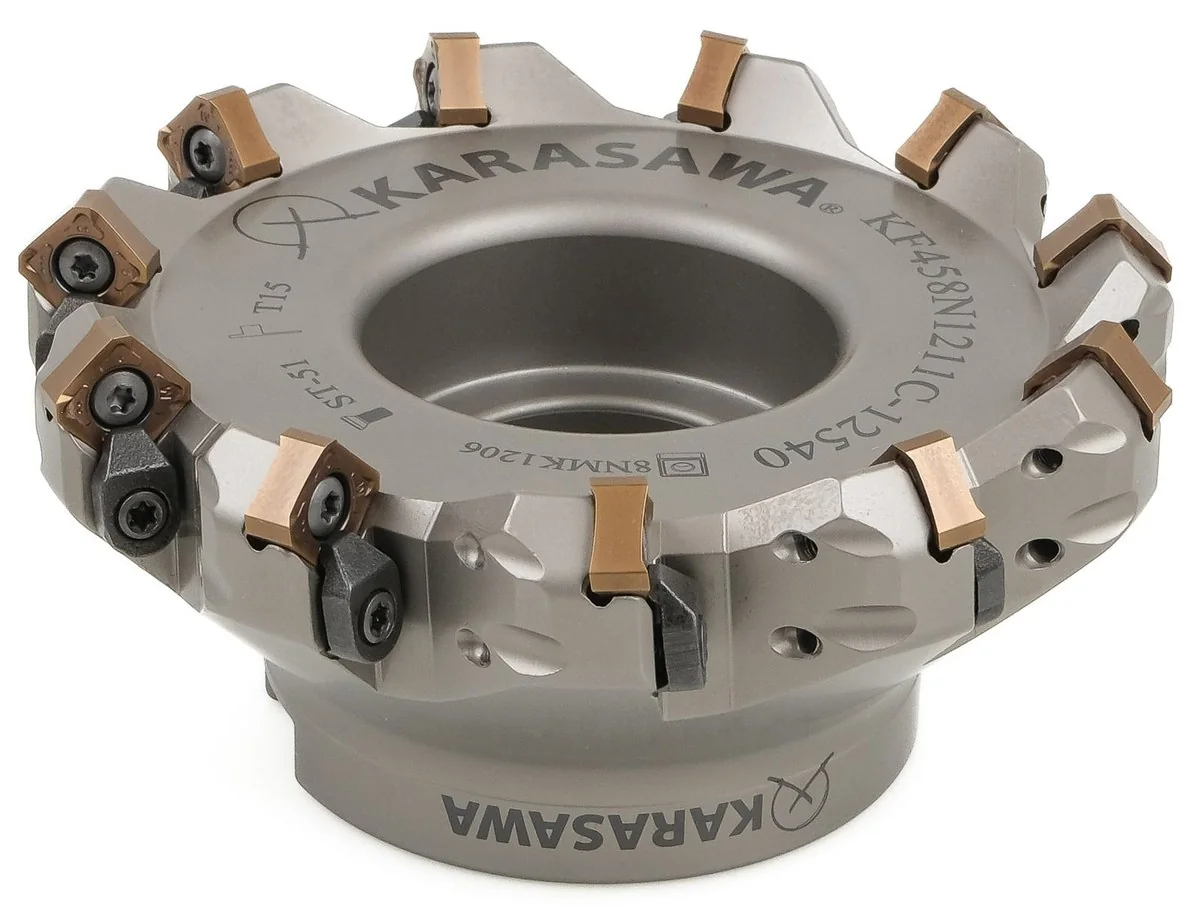
KF458N1211C-12540 · insert 8NMK1206 · screw ST-51 · key T15The 3PMK, 4NMK, 6NMK and 8NMK series. A double-sided insert instead of a single-sided one: the same blank cost is divided not by three edges but by six or eight. On a long run that no longer counts in percentages.
4NMK 1607 — up to 15 mm depth of cut per pass and a wiper facet ground on the edge: the joint between passes is practically invisible on the wall. 6NMK 0403 / 0804 — a trigon double-sided insert, a true 90° in one pass with no shoulder to clean up. 8NMK 1206 — square with eight edges: face, shoulder and chamfer from one body.
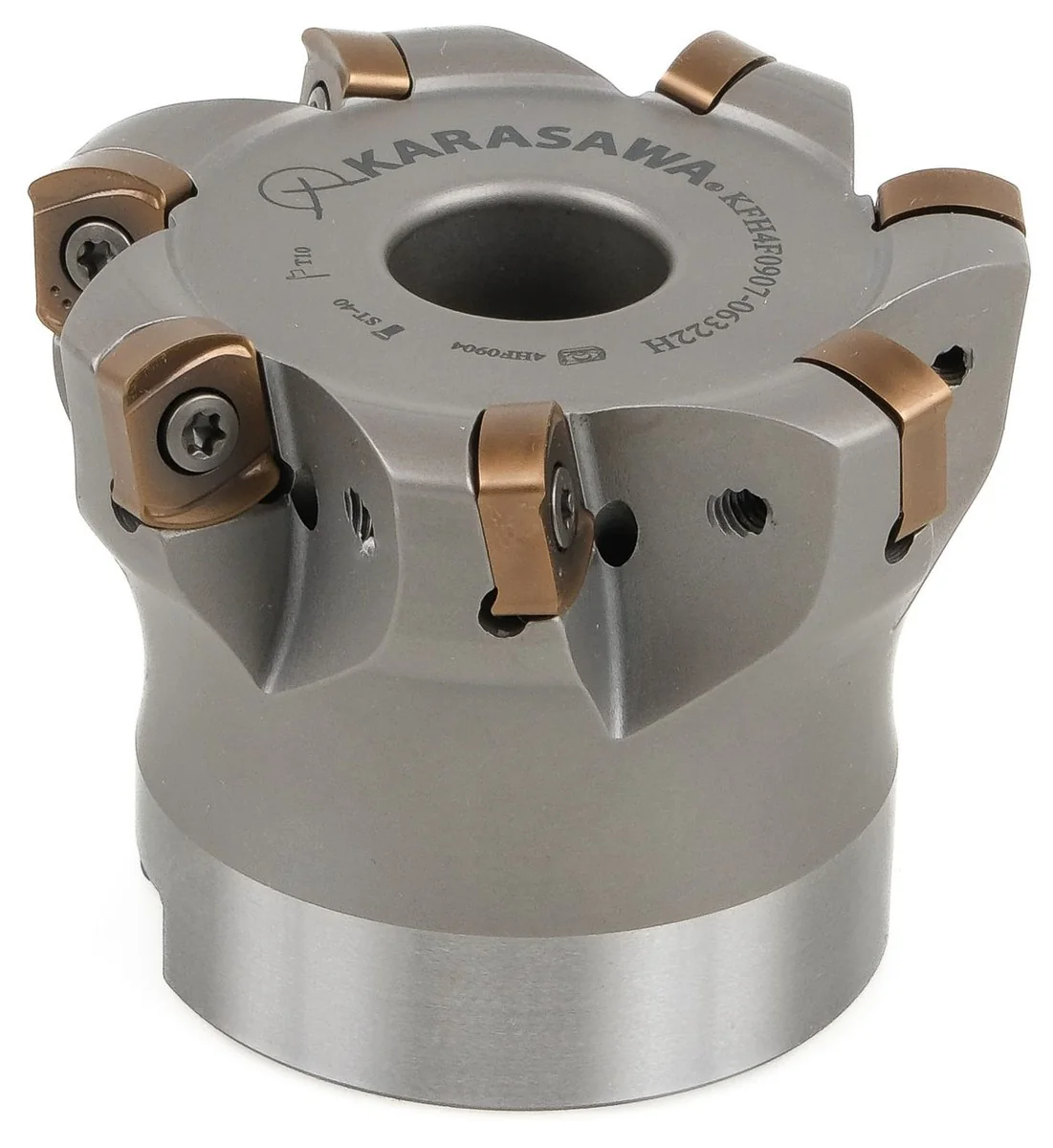
KFH4F0901-06322H · insert 4HF0904 · screw ST-40 · key T10The 4HF, 6HF and SDMT series. A strategy in which you take a small depth of cut at a feed several times the usual. Thanks to the small lead angle the load runs along the spindle axis — the machine takes cutting data that would have shaken it in conventional milling.
4HF 0603 / 0904 — a reinforced four-edge insert with a large rake angle: light cutting without losing edge strength. 6HF 1306 — double-sided with six edges, for when the cost per cubic centimetre removed is what matters. All the series work with straight and helical ramping — a pocket can be opened without pre-drilling.
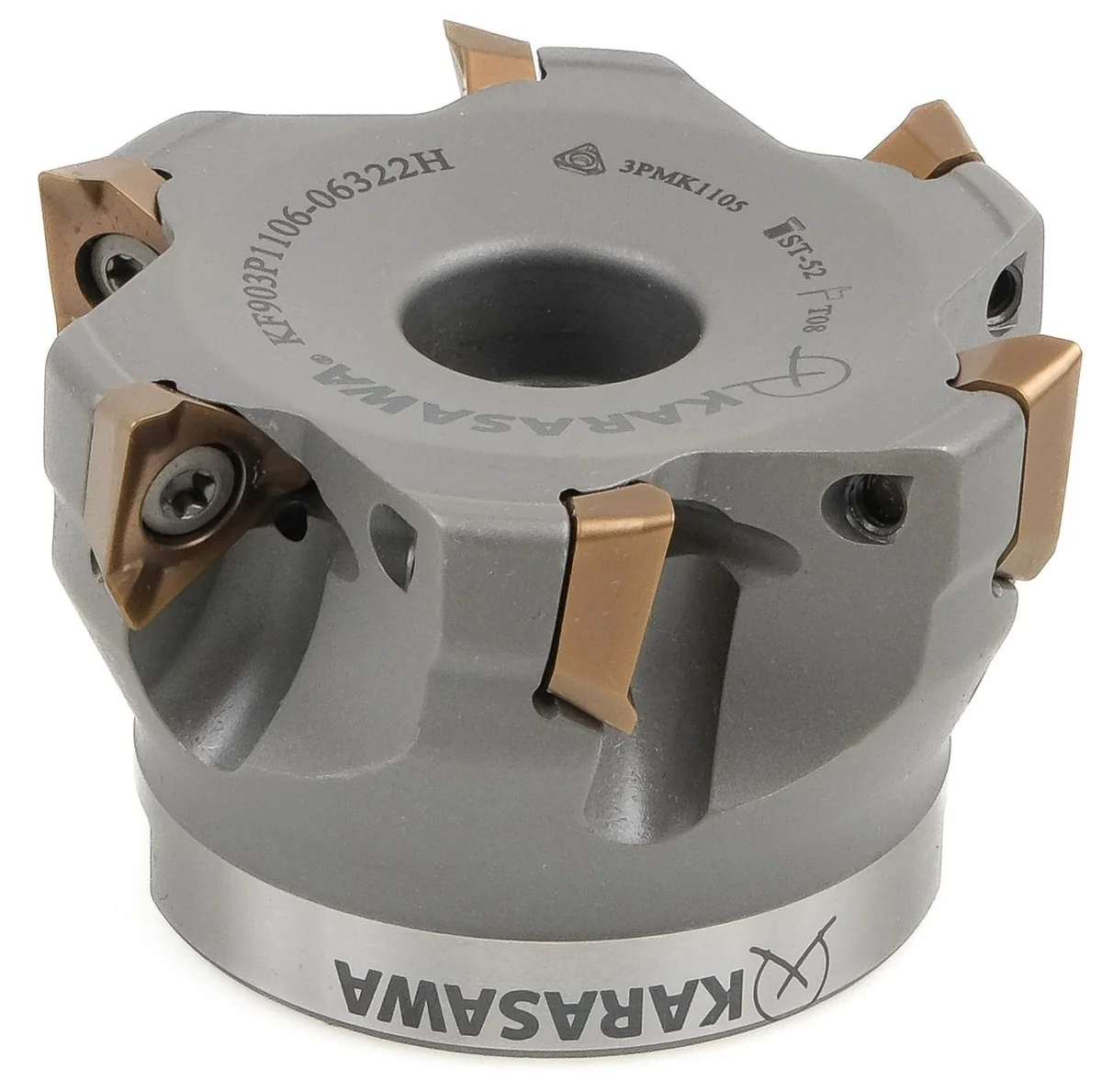
KF903P1106-06322H · insert 3PMK1105 · screw ST-52 · key T08The AOMX and APKT series. Shop-floor classics: walls, slots, pockets, machining from an edge. A positive geometry with a large rake angle — lower cutting forces, less load on the spindle, calmer running on a light machine or at a long overhang.
AOMX 0602 — a small insert for small diameters and thin walls. APKT 1003 / 1604 — the most widely used milling insert in the world: compatibility, availability, cost per edge. Exactly the item a shop buys by the box. Some bodies in this group run the trigon insert 3PMK 1105 — the same 90°, but three edges instead of two.
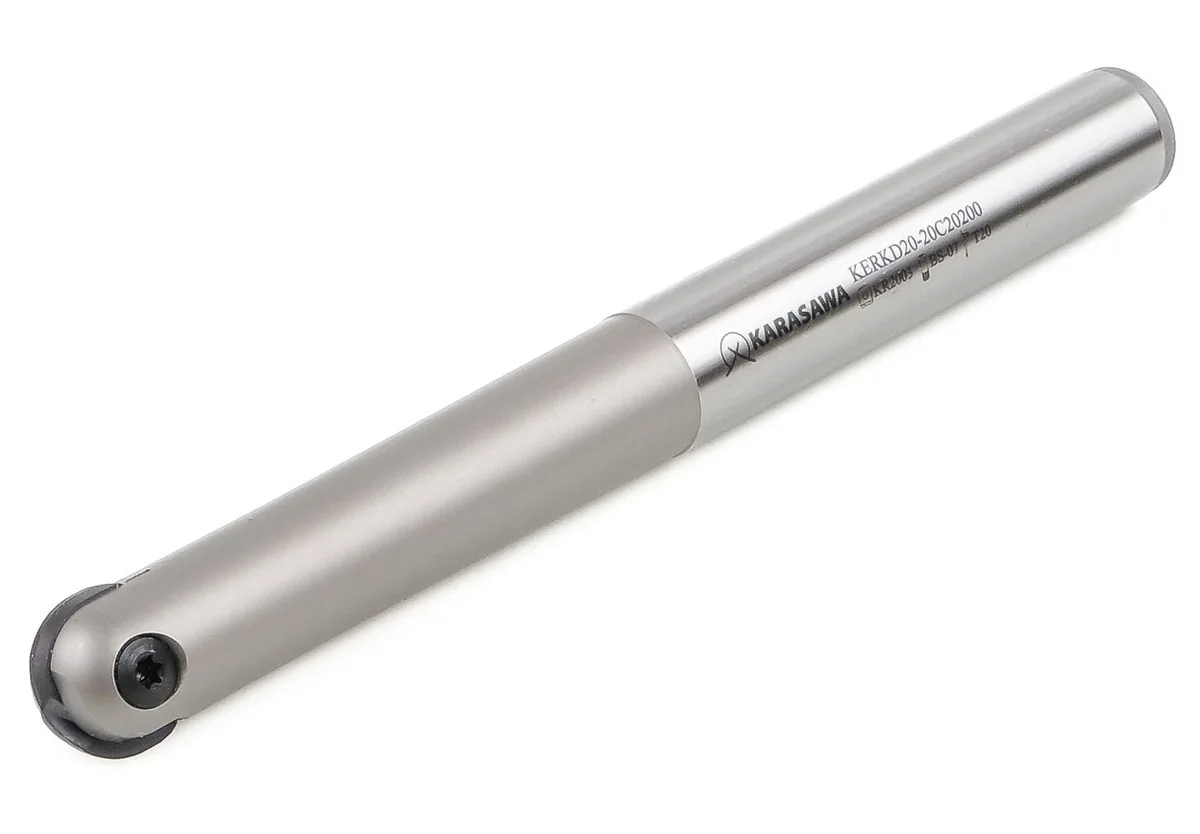
KERKD20-20C20200 · screw BS-07 · key T20The KD series, diameters from 10 to 32 mm. An indexable ball nose insert instead of a solid ball nose end mill: at large diameters the difference in carbide consumption is a multiple.
Work on 3D surfaces: moulds, dies, cavities, blend radii. The insert has a helical cutting edge — the ball cuts rather than scrapes, and at small stepovers it gives a surface that does not need hand finishing.
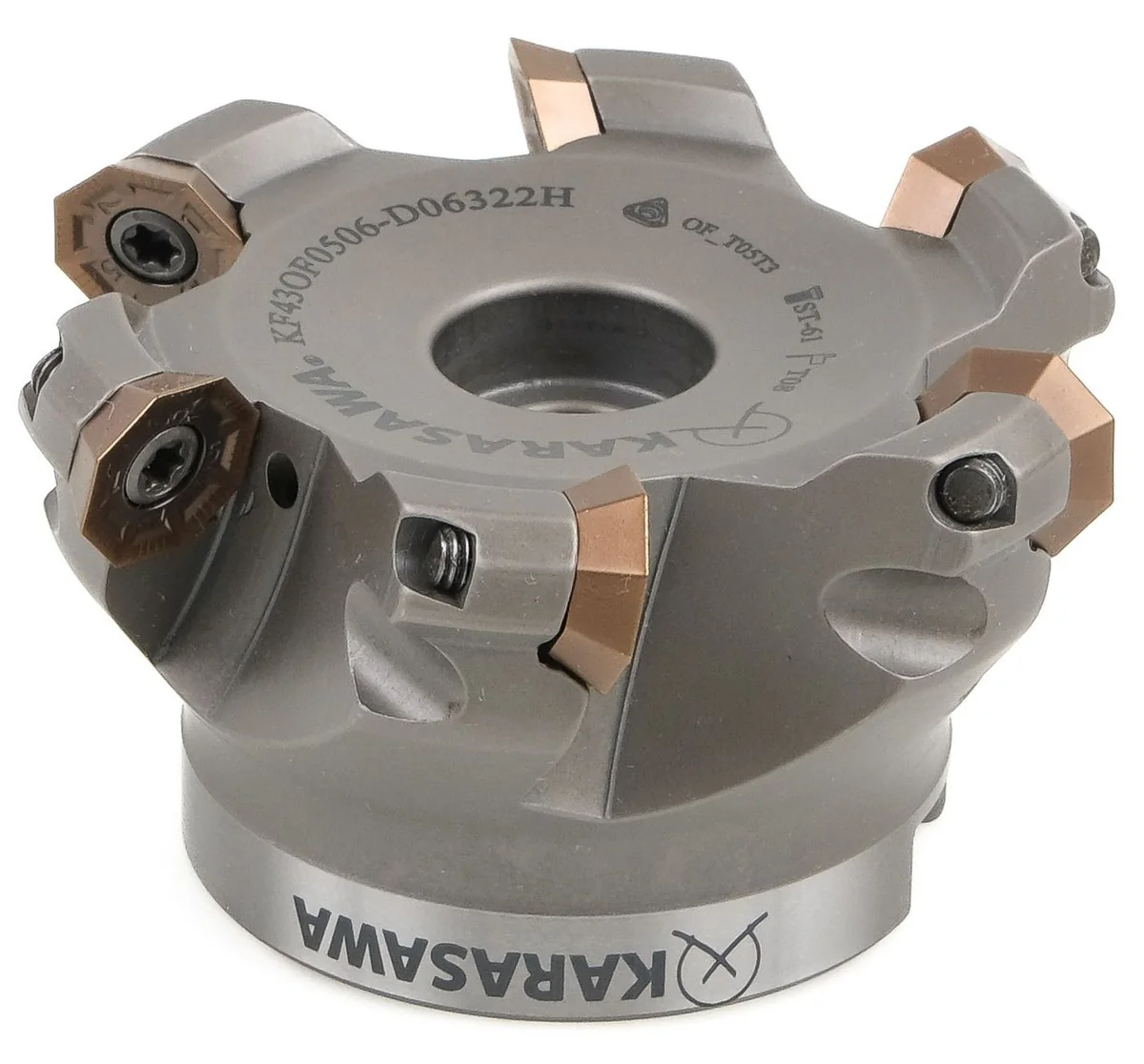
KF43OF0506-D06322H · insert OF..05T3 · screw ST-61 · key T08The SEKT / SEMT, TPKN and OFMT series. Face milling is the operation a shop does every day and the one a machine is judged by. The main criteria here are how much comes off per pass and how the face looks afterwards.
SEKT / SEMT 1204 · 13T3 — a square positive insert, quiet cutting, a clean face. TPKN 1603 · 2204 — trigon for classic 45° cutters, cast iron and steel, when a lot has to come off. OFMT 05T3 — octagonal: eight edges per insert for shallow depths over a large area.
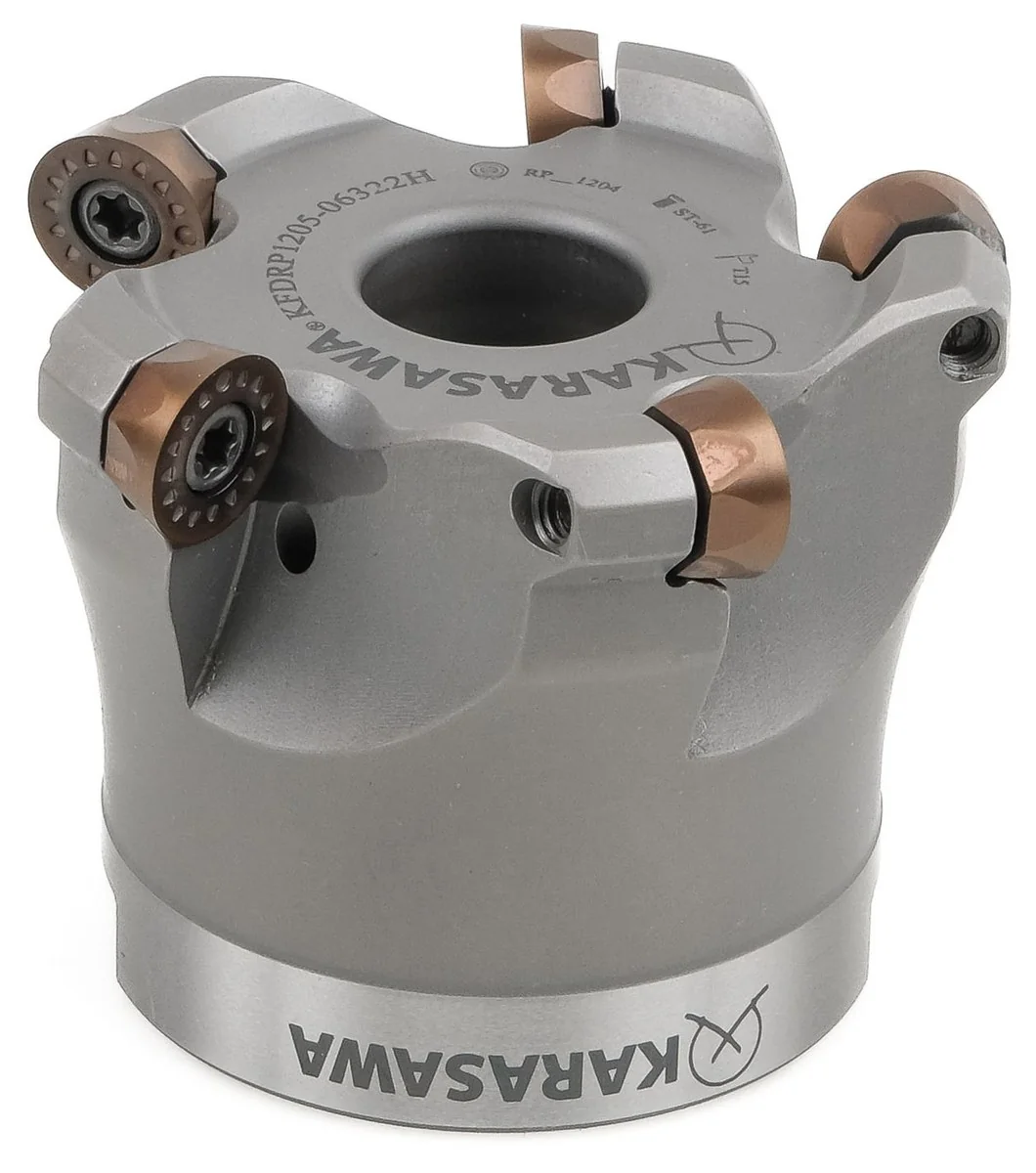
KFDRP1205-06322H · insert RP..1204 · screw ST-61 · key T15The RDMT / RDKW and RPMT series. A round insert is the strongest of them all: it has no corner to break off. Hence its place — heavy roughing, castings with scale, uneven stock, heat-resistant alloys.
The second property of a round insert is that it works equally well at any depth of cut, so one body handles contouring, helical ramping and copying a complex surface alike. Seven sizes from 0501 to 1604 — from small cavities to large housing parts.
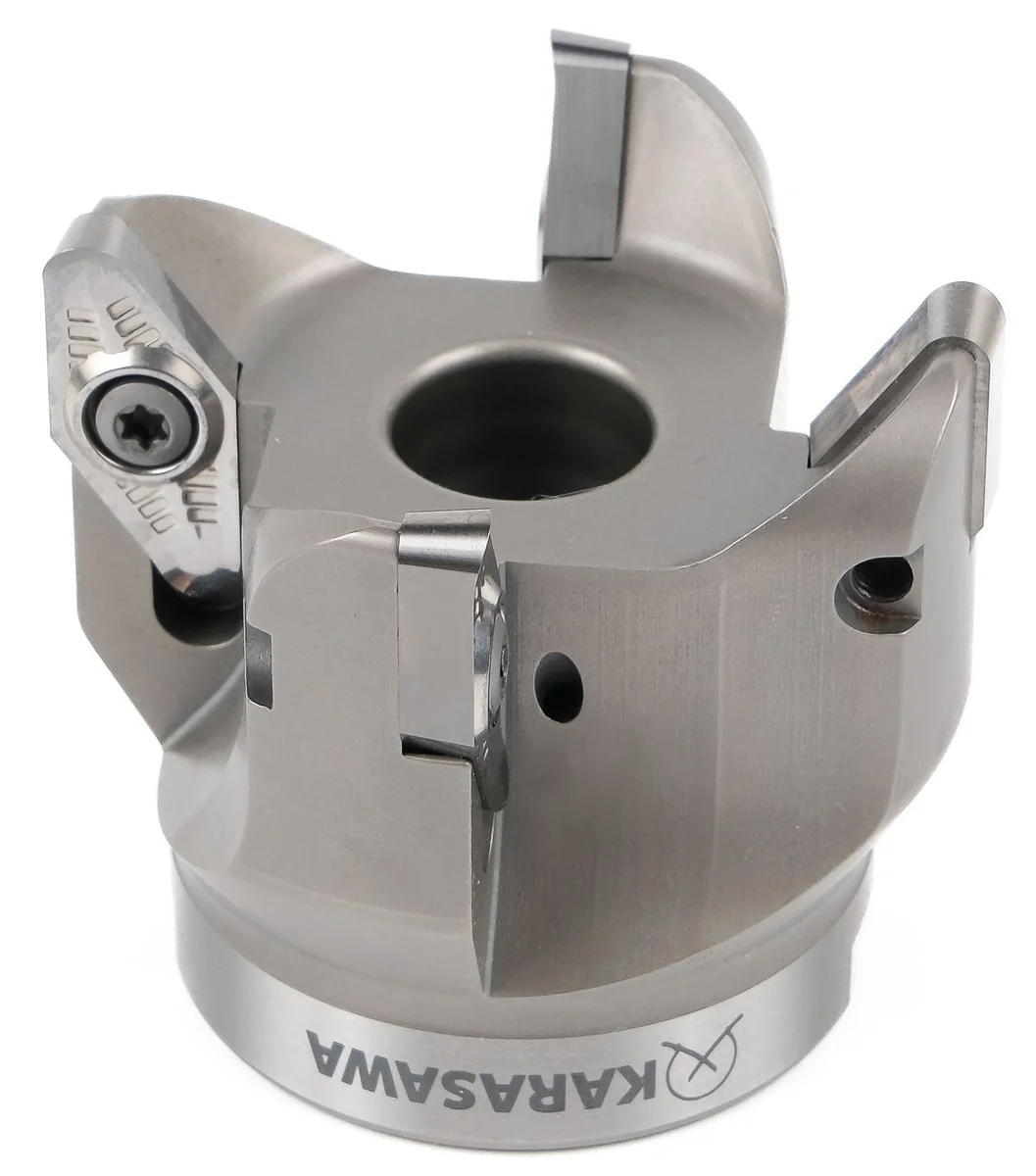
KF90VC2204-06322H · polished insert VC..2204The VCKT, 3PMK, APKT and SEKT / SEMT series in versions for non-ferrous metals. Aluminium does not wear the edge — it sticks to it. So the task here is different: not coating hardness but smoothness and sharpness.
A ground and polished rake face, a large rake angle, a wide chip flute. Metal does not build up on the edge, the chip comes away freely and the surface is mirror-like with no further work. For high cutting speeds and heavy stock removal — housing parts, plates, extruded sections.
Everything needed for a reorder is engraved on the body: the insert type, the screw and the key. Copying that line off the cutter is enough for us to put the order together without further questions.
Insert grades
The question “which grade should I take” is really two questions. The first is what you are cutting: steel, stainless, cast iron, non-ferrous, heat-resistant or hardened. The second, the one people forget, is how you are cutting it: a thin finishing pass, even continuous removal, or roughing a casting with interruptions, where the edge strikes the material hundreds of times a minute.
Those same two questions lie behind the structure of the KARASAWA milling programme. The inserts are produced in four technologies — PVD coating on carbide, CVD coating, tungsten-free grade and polycrystalline diamond. Within each there are several grades, separated precisely by the character of the work.
In the table below the mark in a cell shows not “suitable / unsuitable” but which type of cutting the grade is intended for in that material group. That is the answer to the second question.
| Grade | Technology | P | M | K | N | S | H | Where this works |
|---|---|---|---|---|---|---|---|---|
| Carbide + PVD — a thin coating, a sharp edge | ||||||||
| PH1265finishing | PVD | ○ | ○ | ○ | — | ○ | ● | Fine finishing of hardened material. The highest wear resistance in the line — where size and a mirror finish matter, not stock removal. |
| PH2835universal | PVD | ⊖ | ⊖ | ⊖ | — | ⊖ | ● | Finishing and semi-finishing across the whole range, including hardened steel. The “just in case” grade, for when there are several different materials on the section. |
| PH2255universal | PVD | ⊖ | ⊖ | ⊖ | — | ⊖ | — | The same without the hardened group: steel, stainless, cast iron, heat-resistant alloys — from finishing to semi-finishing. |
| PH2265finishing | PVD | ○ | ○ | ○ | — | ○ | ● | Continuous finishing. The first choice in hardened steel — moulds, dies, parts after heat treatment. |
| PM3215steel and cast iron | PVD | ● | ○ | ● | — | — | — | From semi-finishing to roughing in carbon and alloy steel and cast iron. The grade that sits in most bodies in everyday work. |
| MS3265universal working grade | PVD | ● | ○ | ● | — | ○ | ● | The widest working range among the PVD grades: steel and cast iron in roughing, stainless and heat-resistant alloys in finishing, plus hardened material. One grade for a mixed range of work. |
| PH3255universal | PVD | ⊖ | ⊖ | ⊖ | — | ⊖ | ⊖ | The only grade that reaches into all six groups, hardened material included. A compromise on tool life, but it takes the selection question away. |
| SM3775tough, wide range | PVD | ● | ● | ● | — | ● | ○ | Roughing and semi-roughing in four groups at once — steel, stainless, cast iron, heat-resistant alloys. A tougher substrate: it holds the cutting data where a finer grade already cracks. |
| PM3305steel, finishing | PVD | ○ | ○ | — | — | — | — | Narrowly aimed at finishing and semi-finishing in steel and stainless. For when the surface matters, not the volume removed. |
| MS4265impact-resistant | PVD | ■ | ■ | — | — | ■ | — | Interrupted cutting and unstable conditions: castings, welded structures, slots, edge entry and exit. High resistance to impact and corrosion — the first choice in stainless and heat-resistant alloys. |
| PH4155impact-resistant | PVD | ⊟ | ⊟ | ⊟ | — | ⊟ | — | The second grade for interrupted cutting — this one across all four groups. Taken when conditions are unstable and the material on the section changes from part to part. |
| Carbide + CVD — a thick coating, a thermal barrier | ||||||||
| MS3587universal CVD | CVD | ⊖ | ⊖ | ⊖ | — | — | — | Long passes with a high temperature in the cutting zone. The thick layer acts as a heat shield where PVD is already burning off. |
| PM3587cast iron, dry machining | CVD | ● | ○ | ● | — | ○ | — | Semi-roughing and roughing without coolant. The first choice in cast iron: grey, ductile, brake discs, housing parts, blocks. |
| SM4587roughing CVD | CVD | ■ | □ | ■ | — | □ | — | The toughest duty in the programme: dry interrupted roughing in alloy steel and cast iron. A tough substrate plus a thick coating. |
| Uncoated and diamond — non-ferrous metals | ||||||||
| NN1000tungsten-free | uncoated | — | — | — | ● | — | — | A sharp uncoated edge for aluminium, copper and brass. Finishing and semi-finishing: a coating only gets in the way here — it blunts the edge, and a blunt edge in aluminium produces a built-up edge. |
| NN1090tungsten-free | uncoated | — | — | — | ● | — | — | The second version for non-ferrous metals — with a different balance of hardness and toughness for a more heavily loaded duty. |
| D1700polycrystalline diamond | PCD | — | — | — | ● | — | — | High-silicon aluminium, composites, graphite — abrasive materials that wear an ordinary edge away in a single shift. Tool life here is measured on a different order of magnitude. |
How to read the table in practice. First find your row by material, then the column carrying the mark for your type of cutting. If there is one part and the conditions are stable, take the narrow grade: it will give longer life. If the section runs different materials every day and nobody is going to change the insert for each part — take the one with marks in four groups at once. That is a deliberate trade of tool life for simplicity, and in a real shop it often pays better.
In summary
Seven body groups and seventeen grades is not about the length of the catalogue. It is about three things that show up by the second month of work.
Six or eight edges per insert instead of three, and a body with a wear-resistant coating that will outlive dozens of insert sets. The cost of removing metal stops being a figure nobody in the shop knows.
Shoulder, face, high-feed, copy milling, contouring, aluminium — one price list and one delivery note. Instead of four suppliers, each with their own lead times and their own account manager.
Common sizes are held in stock. An insert you have to wait three weeks for stops not one operation but the whole route of the part.